Connect your tools
One-line installers for Claude Code, Codex, Kimi CLI, Raycast, and the CLI.
Connecting a tool lives under Integrations in the dashboard, and there are two ways to do it:
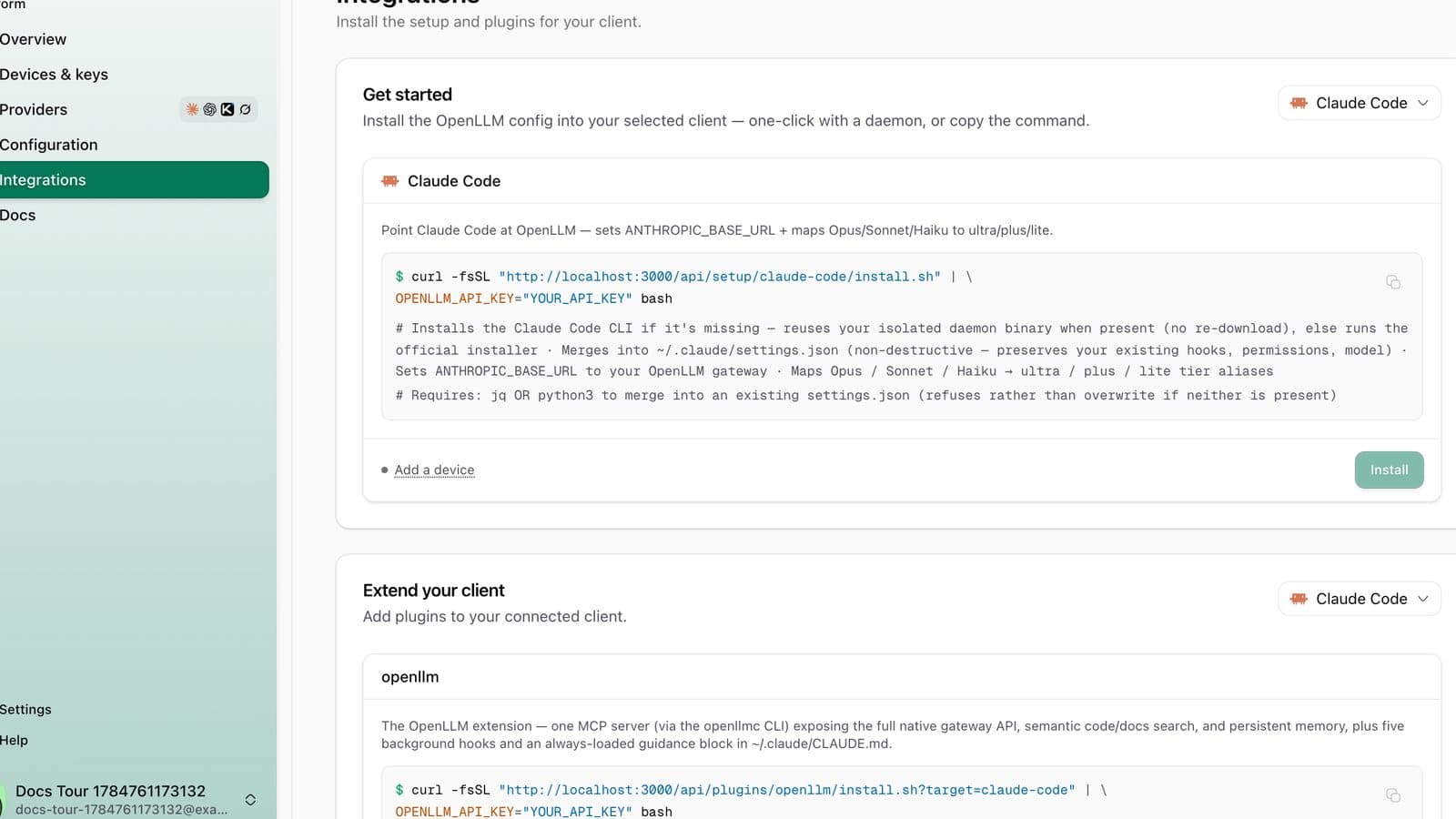
- One-click. Pick the client on the Integrations page and hit install. This works through the local daemon on the target device: the dashboard shows each paired device with its online status, and installs, updates, and uninstalls run on that machine with one click — no terminal needed.
- Copy the command. Every tool also has a one-line installer, listed on the
same page and below, that bakes in the gateway URL and your key. Swap
sk-llm-YOUR_KEYfor your own key from the dashboard.
Either way the result is non-destructive: the installer backs up and merges into your existing config instead of overwriting it, and the one-click uninstall reverses cleanly.
Claude Code
curl -fsSL "https://openllm.sh/api/setup/claude-code/install.sh" \
  | OPENLLM_API_KEY="sk-llm-YOUR_KEY" bash
Merges into ~/.claude/settings.json (preserving your hooks, permissions, and
model), sets ANTHROPIC_BASE_URL to your gateway, and maps Opus, Sonnet, and
Haiku to ultra, plus, and lite. Needs jq or python3 to merge safely.
Restart Claude Code after install.
Codex
curl -fsSL "https://openllm.sh/api/setup/codex/install.sh" \
  | OPENLLM_API_KEY="sk-llm-YOUR_KEY" bash
Adds an openllm provider block to ~/.codex/config.toml and selects it,
defaulting the model to the ultra chain. It also fetches your model catalog so
Codex sizes auto-compaction correctly and stops warning about missing metadata.
Kimi CLI
curl -fsSL "https://openllm.sh/api/setup/kimi-code/install.sh" \
  | OPENLLM_API_KEY="sk-llm-YOUR_KEY" bash
Adds an openllm provider to ~/.kimi-code/config.toml and writes a model entry
for each of your activated models, which the Kimi CLI requires.
Raycast
curl -fsSL "https://openllm.sh/api/setup/raycast/install.sh" \
  | OPENLLM_API_KEY="sk-llm-YOUR_KEY" bash
Merges an openllm custom provider into Raycast's providers.yaml with every
activated model and its real context window. Needs a Raycast plan that supports
custom AI providers. After install, enable Custom Providers under Settings → AI
and restart Raycast.
OpenLLM CLI
curl -fsSL "https://openllm.sh/api/setup/cli/install.sh" | bashInstalls openllmc, a self-contained binary (no node or bun needed) that serves
one MCP server exposing the full gateway API, semantic code and docs search, and
persistent memory. It verifies its download against a published SHA-256 checksum
and self-updates against the gateway's pinned release. After a sandboxed install,
run ~/.openllm/bin/openllmc setup to finish shell completion.
The local daemon
Subscription accounts (Claude Code, ChatGPT, Kimi over OAuth) need a small daemon running on your machine, because those credentials never route through the cloud.
curl -fsSL "https://openllm.sh/api/setup/daemon/install.sh" \
  | OPENLLM_API_KEY="sk-llm-YOUR_KEY" bash
Installs openllmd, runs subscription inference locally against the official
vendor CLIs, and sets up a launch agent (macOS) or systemd user unit (Linux) so
it stays running across logout and reboot. Control it with openllmd start,
openllmd stop, and openllmd status. See Providers and
Compliance for why this runs locally.
The daemon is also what powers the one-click installs above: once a device is paired, the Integrations page can install, update, or uninstall any client on that machine remotely.
macOS and Linux only
The CLI and daemon are compiled binaries for macOS and Linux. There is no Windows build today.